
Channel letter estimating software and channel letter estimator for sign shops
Channel letter estimating software turns letter count, letter height, return depth and stroke length into a full take-off: face and back sheets nested with waste, linear feet of returns and trim cap, LED modules, power supplies, router and bender hours, shop labor, install crew, lift and travel. SignEstimator does that math with your own material costs and rates, and shows the sale price and real margin before the quote leaves the shop.
Plans start at $24 per month billed yearly with seats included. Describe one set in the demo below and see the line items in under a minute.
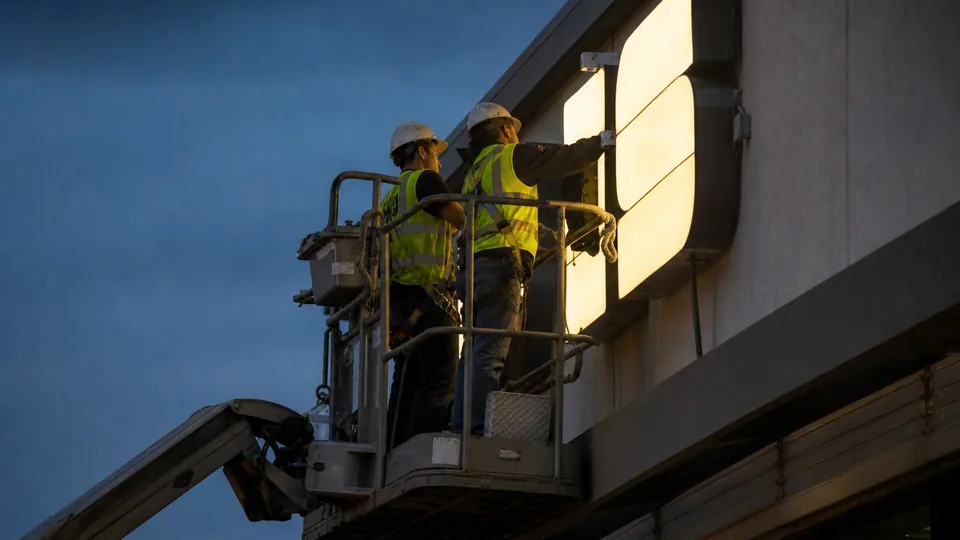
Estimate this job
- Materials
- Machine time
- Install
- Pricing
What a channel letter estimator has to count
A set of channel letters is a small metal fabrication job, an electrical job and an install job at the same time. A price per letter or per square foot can be a sanity check, but it cannot see the things that move your cost. Thin script letters have far more return and trim cap per square foot than a block font. A halo lit set needs standoffs, a pattern and a painted face. A storefront at 28 feet needs a bigger lift than one at 14.
A channel letter estimator in SignEstimator counts each of those parts for you.
- Face sheets. Acrylic or aluminum faces nested on 4x8 or 5x10 sheets, with your waste factor.
- Backs. Aluminum or clear polycarbonate backs, nested the same way.
- Returns. Linear feet of coil from the face perimeter at the depth you build, plus waste.
- Trim cap. Linear feet that follow the face perimeter on front lit letters.
- LED modules. Module count from total stroke length and your modules per foot of stroke.
- Power supplies. Total watts divided by the usable watts of one supply at your loading rule, rounded up.
- Raceway, backer or flush mount. Linear feet of raceway or a backer panel, or penetrations per letter.
- Machine time. Router and bender hours from your own speeds.
- Shop labor. Assembly, LED layout and wiring, paint and pattern hours.
- Site work. Survey, permit, crew hours, lift or crane class by height, travel and an electrician if you sub it out.
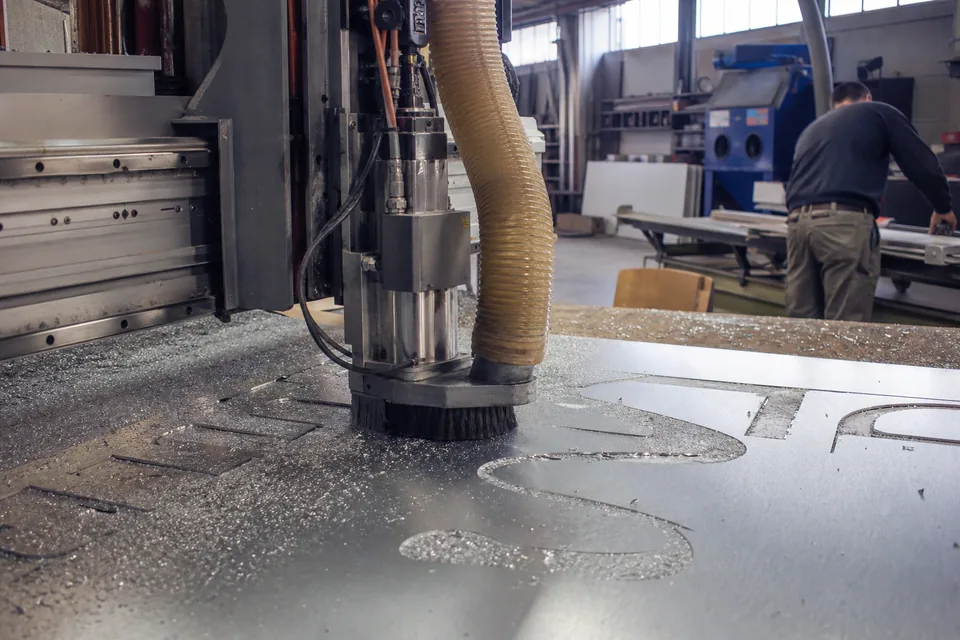
From four inputs to a full channel letter take-off
You do not need a drawing package to start. Four numbers carry most of the estimate, and the rest comes from your shop library.
| You enter | What the estimator derives |
|---|---|
| Letter count and letter height | Face and back area, sheet count after nesting, letter weight class for install |
| Return depth | Coil cost per foot, bender time, LED spacing rule |
| Stroke length | LED module count, total watts, power supply count |
| Install height and distance | Lift or crane class, crew size and hours, travel miles |
Your library holds the costs behind those lines: unit cost, sheet size and waste factor for each material, cost per hour for the router, laser, printer and bender, labor rates by role, overhead percent and target margin. You load it once by CSV import or start from the built-in starter library and edit the numbers to match your vendors.
When a line looks wrong for a given job, you change it on that estimate. A tight wall that needs a smaller crew, a landlord who requires a licensed electrician, or a customer who wants a second color of vinyl on the faces are all one line edit, and the total and margin update while you type.
A halo lit channel letter estimate, line by line
Example numbers, use your own rates. In this example a shop prices 8 halo lit letters, 18 in tall, with 3 in deep aluminum returns and aluminum faces, pin mounted on standoffs on a stucco wall at about 12 ft. The job is 20 miles from the shop.
In this example the total face perimeter is 44 linear feet and the total stroke length is 30 feet. With 10 percent waste the returns need about 49 feet of coil. At 2 modules per foot of stroke the set takes 60 LED modules. At 0.72 W each that is 43.2 W, which fits on one 60 W supply loaded to 80 percent (48 W usable).
| Line | Qty | Unit | Rate | Line cost |
|---|---|---|---|---|
| Aluminum faces, .090, nested | 1 | sheet | $140.00 | $140.00 |
| Clear polycarbonate backs, nested | 1 | sheet | $150.00 | $150.00 |
| Aluminum returns, 3 in, with waste | 49 | linear ft | $1.00 | $49.00 |
| LED modules, 2 per foot of stroke | 60 | module | $1.60 | $96.00 |
| Power supply, 60 W at 80 percent loading | 1 | each | $55.00 | $55.00 |
| Standoffs and pin hardware | 1 | lot | $60.00 | $60.00 |
| Paint for faces and returns | 1 | lot | $110.00 | $110.00 |
| Router time, faces and backs | 1.5 | hour | $95.00 | $142.50 |
| Bender time, returns | 1.5 | hour | $85.00 | $127.50 |
| Fabrication and assembly | 8 | hour | $55.00 | $440.00 |
| LED layout and wiring | 3 | hour | $55.00 | $165.00 |
| Paint labor | 4 | hour | $55.00 | $220.00 |
| Install pattern and shop drawings | 1.5 | hour | $75.00 | $112.50 |
| Install crew, 2 installers x 4 hours | 8 | crew hour | $75.00 | $600.00 |
| 19 ft scissor lift | 1 | day | $225.00 | $225.00 |
| Travel, 20 miles each way | 40 | mile | $1.25 | $50.00 |
| Permit, fee and filing time | 1 | each | $250.00 | $250.00 |
| Electrician final connection, subcontractor | 1 | each | $250.00 | $250.00 |
Totals and margin
| Group | Amount |
|---|---|
| Materials | $660.00 |
| Machine and shop labor | $1,207.50 |
| Install, lift, travel, permit, electrician | $1,375.00 |
| Direct cost | $3,242.50 |
| Overhead at 20 percent of direct cost | $648.50 |
| Total cost | $3,891.00 |
| Sale price at 35 percent target margin, $3,891.00 / 0.65, rounded | $5,986.00 |
| Gross profit | $2,095.00 |
| Real margin, $2,095.00 / $5,986.00 | 35.0 percent |
In this example the set sells for about $748 per letter. Shop labor is almost double the materials, which is normal for halo letters because the faces and returns are painted and the letters are seen from every angle. A square foot price built on front lit jobs would have missed that labor. For the full method behind each line, read how to price channel letters, and for a front lit set on a raceway see our channel letter pricing example.
Templates for every channel letter style
Each template starts with the lines that style always needs, so nobody forgets the standoffs on a halo set or the trim cap on a front lit one.
| Template | Lines it adds by default |
|---|---|
| Front lit | Acrylic faces, trim cap, translucent vinyl option, LEDs facing the face, raceway or flush mount |
| Halo lit (reverse channel) | Aluminum faces, clear backs, standoffs, install pattern, extra paint and finish hours |
| Open face | No face sheet, painted interior, exposed LED or neon style lighting, optional clear face |
| Dimensional letters | No LEDs or power supplies, routed or fabricated letters, studs and pattern |
Many shops quote the same build every week, such as a 5 in return front lit set on a painted raceway. Duplicate a past estimate, change the letter count and height, and the take-off and price follow, so your estimators start from a set that already matches how your shop builds.
Raceway, backer or flush mount
Mounting changes both shop and site lines. A raceway adds linear feet of extrusion, paint and a build hour or two, and usually saves install time because the electrician makes one connection. Flush mount drops the raceway but adds a wall penetration and a remote power supply location per letter. A backer panel adds a cabinet style line with its own material. SignEstimator keeps those as switchable lines so the estimate shows the difference, and you can quote the customer both options.
Install, lift and permit lines on every set
On most storefront jobs, site work is a large share of the cost, and it is the part spreadsheets leave out. In SignEstimator the install height you enter picks the lift or crane class from your own equipment list or rental rates. Crew size and hours are their own lines. Distance adds travel. Survey, permit and an electrician subcontract are lines you can switch on per job, and the template remembers which ones your area usually needs.
That means the quote for a set at 30 feet over a busy sidewalk carries a boom lift, an extra flagger hour and a longer permit lead time, while the same letters at 12 feet over a parking lot do not. More on crew and equipment pricing on our sign installation estimating page.

How SignEstimator compares with other ways to estimate channel letters
| Spreadsheet | LED supplier layout tools | Full shop management platforms | SignEstimator | |
|---|---|---|---|---|
| Returns and trim cap by perimeter | If you build the formula | No | Depends on how you set up products | Yes, from perimeter with waste |
| LED and power supply count | If you build the formula | Yes, the core feature | Depends on setup | Yes, from stroke length and loading rule |
| Sheet nesting for faces and backs | No | No | Rarely | Yes, on your sheet sizes |
| Machine and shop labor | Manual lines | No | Yes, after setup | Yes, from your machine rates |
| Install crew, lift and crane by height | Manual lines | No | Usually | Yes, by install height |
| Branded quote with online approval | No | No | Yes | Yes |
| Typical setup | Days of building and upkeep | None | Weeks, often with paid onboarding | Same day with the starter library |
| Price | No software cost | Usually free from the supplier | Often a base price plus a fee per user | From $24 per month billed yearly, seats included |
LED supplier tools are good at what they do, and many shops use them to check a module layout. They do not price the job. Full platforms such as shopVOX run production, purchasing and inventory as well, which a large shop may need. If you are weighing one, our shopVOX alternative page compares both on price and setup.
Start from a storefront photo or the landlord's sign criteria
Snap the fascia on your phone or drop in the sign criteria PDF from the property manager. AI reads it into a draft spec with letter count, approximate height, style and install height, and picks the matching template. You check the numbers and adjust them before anything is priced. Pricing always uses your own materials and rates, never a market average. Read more about AI quote drafts.
The quote goes out as a branded PDF or as a link. The customer approves online and signs by typing a name, and the approved estimate becomes a work order with the same line items on the Team plan.
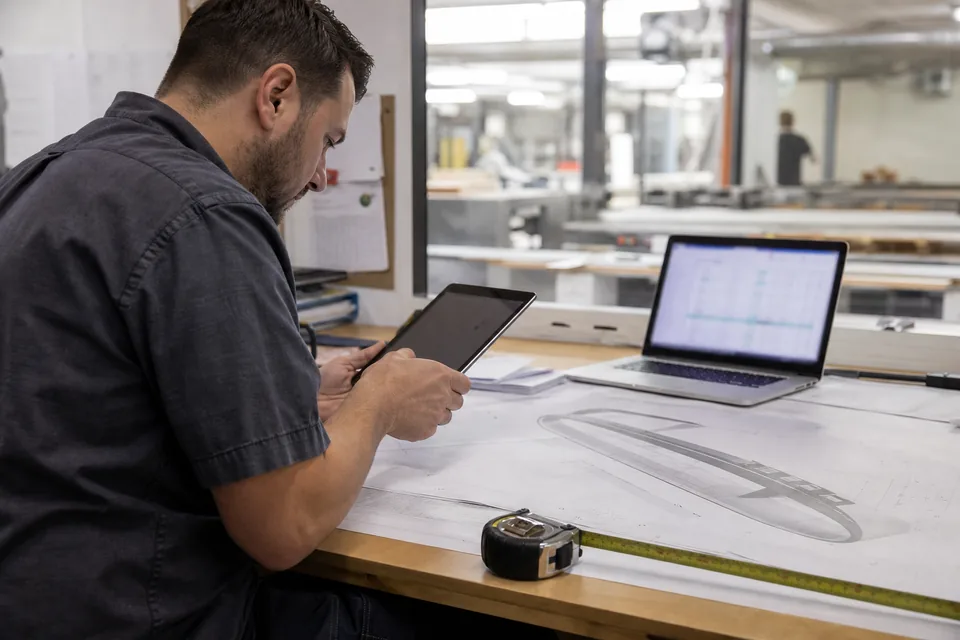
Who uses channel letter estimating software
- Sign shops that fabricate letters in house and need the shop hours priced right.
- Shops that buy letters wholesale and add install, permit and electrical on top.
- Electric sign companies quoting national accounts with the same set on many storefronts.
- Estimators who quote dozens of sets a month and want every quote built the same way.
- Owners who want to see margin by job before it is sent, not after it is installed.

Frequently asked questions
[email protected]Estimate channel letters part by part. Nest faces and backs on your sheet sizes, measure the face perimeter for returns and trim cap, count LED modules from stroke length and power supplies from total watts, then add router, bender and shop hours, install crew, lift, travel and permit. Add overhead and divide by one minus your target margin.
Multiply the total stroke length by your modules per foot of stroke. Many shops use 2 to 4 modules per foot depending on return depth, face color and module brightness. A set with 60 feet of stroke at 3 modules per foot needs 180 modules. Check the spacing against your LED supplier's guide.
Add the watts of every LED module in the set and divide by the usable watts of one power supply. Many shops load supplies to 80 percent, so a 60 W supply carries 48 W. Always round up, and split the load by letter groups if the wiring runs are long.
SignEstimator costs $24 per month billed yearly for one user, $74 for up to 5 seats and $199 for up to 20 seats, or $49, $149 and $399 billed monthly. Full shop management platforms often charge a base price plus a fee per user and an onboarding fee.
Yes. Every estimate prices from your library: material unit costs, sheet sizes and waste factors, machine rates, labor rates by role, overhead and target margin. You can import materials by CSV, edit the starter library, and change any line on a single job.
Yes. The halo lit template uses aluminum faces, clear backs, standoffs, an install pattern and extra paint hours, with no trim cap. There are also templates for front lit, open face and non lit dimensional letters.
Estimate your next channel letter set with your own rates
Describe one set in the demo and see the take-off, the line items and the margin. Then load your rates and quote every set the same way. Plans start at $24 per month billed yearly, with seats included and no setup fee.