
Pricing a channel letter sign, line by line
Pricing a channel letter sign means pricing each part of each letter, not the square footage of the box around the word. You count face sheets, linear feet of returns and trim cap, LED modules per foot of stroke, power supplies, raceway, machine and shop hours, then survey, permit, crew, lift and travel. Add overhead and solve for your target margin.
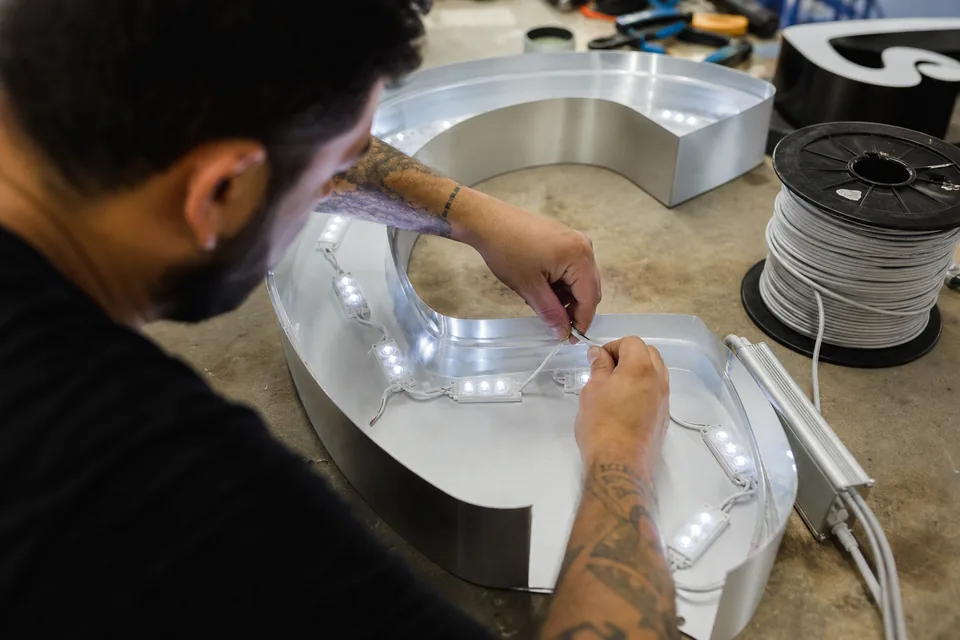
Estimate this job
- Materials
- Machine time
- Install
- Pricing
Why a square foot price fails on channel letters
Two signs with the same overall size can cost very different amounts. A word with thin strokes and many letters has more returns, more trim cap and more bending than a short word with wide letters. A halo lit set needs standoffs and a clean wall. A sign at 30 feet needs a bigger lift than a sign at 15. A single rate per square foot hides all of that. A line by line estimate shows it, so you can price the hard jobs right and stay sharp on the easy ones.
The parts every channel letter estimate needs
- Faces. Acrylic sheets nested on 4x8 or 5x10 sheets, with waste.
- Backs. Aluminum sheet cut on the router.
- Returns. Aluminum coil by the linear foot, at the return depth you build.
- Trim cap. Linear feet that match the face perimeter.
- LED modules. Count from the total stroke length and your modules per foot of stroke.
- Power supplies. Total watts divided by the supply size at 80 percent loading.
- Raceway or backer. Linear feet of raceway, or a backer panel when the wall needs it.
- Machine time. Router and bender hours.
- Shop labor. Assembly, LED and wiring, paint.
- Site work. Survey, permit, install crew hours, lift or crane, travel, electrician if you sub it out.
- Overhead and margin. The shop costs every job carries, and the profit you keep.

A front lit channel letter estimate, step by step
Example numbers, use your own rates. In this example a shop prices 12 front lit channel letters, 24 in tall, with 5 in deep aluminum returns, mounted on a painted raceway on a storefront at about 18 ft. The job is 30 miles from the shop.
Measure the letters first
In this example the letters have a total face perimeter of 84 linear feet and a total stroke length of 60 feet. Perimeter drives returns and trim cap. Stroke length drives LED count. The faces nest on two 4x8 sheets of 3/16 in white acrylic, and the backs nest on two 4x8 sheets of .063 aluminum. The returns get a 10 percent waste allowance, so 84 feet becomes about 92 feet of coil.
Count LEDs and power supplies
In this example the shop runs 3 LED modules per foot of stroke. 60 feet of stroke times 3 gives 180 modules. At 0.72 W per module, the load is 129.6 W. A 60 W power supply loaded to 80 percent carries 48 W. 129.6 W divided by 48 W is 2.7, so the job needs 3 power supplies.
The line by line estimate
| Line | Qty | Unit | Rate | Line cost |
|---|---|---|---|---|
| Face acrylic, 3/16 in white, 4x8 sheets nested | 2 | sheet | $165.00 | $330.00 |
| Backs, .063 aluminum, 4x8 sheets nested | 2 | sheet | $120.00 | $240.00 |
| Aluminum coil returns, 5 in deep, with 10 percent waste | 92 | linear ft | $1.10 | $101.20 |
| Trim cap, 1 in | 92 | linear ft | 45 cents | $41.40 |
| LED modules, 3 per foot of stroke | 180 | module | $1.60 | $288.00 |
| Power supplies, 60 W at 80 percent loading | 3 | each | $55.00 | $165.00 |
| Raceway, painted to match | 16 | linear ft | $22.00 | $352.00 |
| Wire, disconnect switch, hardware | 1 | lot | $85.00 | $85.00 |
| Primer and paint for returns and raceway | 1 | lot | $95.00 | $95.00 |
| Router time, faces and backs | 3 | hour | $95.00 | $285.00 |
| Bender time, returns | 2.5 | hour | $85.00 | $212.50 |
| Assembly, returns, trim cap and backs | 10 | hour | $55.00 | $550.00 |
| LED layout and wiring | 5 | hour | $55.00 | $275.00 |
| Raceway build and paint labor | 4 | hour | $55.00 | $220.00 |
| Shop drawings and pattern | 2 | hour | $75.00 | $150.00 |
| Site survey | 1 | visit | $150.00 | $150.00 |
| Permit, fee and filing time | 1 | each | $350.00 | $350.00 |
| Install crew, 2 installers x 5 hours | 10 | crew hour | $75.00 | $750.00 |
| 45 ft boom lift | 1 | day | $425.00 | $425.00 |
| Travel, 30 miles each way | 60 | mile | $1.25 | $75.00 |
| Electrician final connection, subcontractor | 1 | each | $250.00 | $250.00 |
Totals and margin math
| Group | Amount |
|---|---|
| Materials | $1,697.60 |
| Machine and shop labor | $1,692.50 |
| Survey, permit, install, lift, travel, electrician | $2,000.00 |
| Direct cost | $5,390.10 |
| Overhead at 20 percent of direct cost | $1,078.02 |
| Total cost | $6,468.12 |
| Sale price at 35 percent target margin, $6,468.12 / 0.65, rounded | $9,951.00 |
| Gross profit, $9,951.00 minus $6,468.12 | $3,482.88 |
| Real margin, $3,482.88 / $9,951.00 | 35.0 percent |
| Markup, $3,482.88 / $6,468.12 | 53.8 percent |
In this example the set sells for $9,951, about $829 per letter. Notice where the money goes. Site work is $2,000, more than all the materials. The lift alone is a quarter of the materials bill. A quote that skips survey, permit or lift class loses most of its margin on install day.
How the same job changes with a different setup
In this example, if the shop priced with a 35 percent markup instead of a 35 percent margin, the price would be $8,731.96. That is $1,219.04 less for the same work. If the letters go up to 30 ft and need a larger lift, change the lift line and the crew hours, and the sale price moves with them. Learn the full method in how to price channel letters.
Front lit, back lit (halo) and open face letters
Each style changes different lines in the estimate. Start from the right template, and the lines follow. Our channel letter estimating software page shows a halo lit set priced from four inputs.
| Style | What changes in the estimate |
|---|---|
| Front lit | Acrylic faces with trim cap, LEDs facing the face, raceway or flush mount, translucent vinyl if the face color is not stock |
| Back lit (halo) | Aluminum faces welded or bonded to returns, no trim cap, clear polycarbonate backs, LEDs aimed at the wall, standoffs and a paper pattern for pin mounting, more finish time because the letters are seen from every angle |
| Open face | No face sheet, exposed LED or neon style lighting, painted interior, often a clear protective face, more paint and finish hours |
Front lit channel letters
Front lit letters are the most common set. The face sheet and trim cap are the visible lines. LED count follows stroke length. Most installs go on a raceway, which saves wall penetrations and makes the electrician's job simpler. When the wall allows it, flush mount removes the raceway line and adds a wall penetration per letter.
Back lit (halo) channel letters
Halo letters glow on the wall behind them. The face is aluminum, so there is no acrylic face and no trim cap. The back is clear, the LEDs point backward, and the letters stand off the wall on spacers. The wall color matters, because the halo reflects off it. Price more install time for pin mounting with a pattern, and more finish time, since the returns and faces are painted.
Open face channel letters
Open face letters show the light source. They need careful LED or neon style layout, a painted interior and often a clear face for weather and safety.
A channel letter price calculator that knows returns and LEDs
SignEstimator has a channel letter template for each style. Enter letter count, letter height, return depth and stroke length, or upload a photo of the storefront. The channel letter price calculator nests faces on your sheet sizes, counts linear feet of returns and trim cap, counts LED modules from your modules per foot of stroke and picks the number of power supplies at your loading rule. Install height picks the lift or crane class, and distance adds travel.
- Your materials, with unit cost, sheet size and waste factor, from CSV import or the starter library.
- Your machine rates for router, laser, printer and bender.
- Your labor rate, overhead percent and target margin.
- A real margin preview before the quote leaves the shop.
For a quick price on a single sign, try the sign pricing calculator. For lifts, cranes and crew time, see sign installation estimating.
Start from a photo instead of a tape measure
Snap the storefront or drop in the landlord's sign criteria PDF. AI reads it into a draft spec with letter count, height and style. Pricing always uses your own materials and rates, and you review every line before you send it. The quote goes out as a branded PDF or a quote link, and the customer approves online and signs by typing a name.
Frequently asked questions
[email protected]Price each part. Count face sheets, linear feet of returns and trim cap, LED modules per foot of stroke, power supplies, raceway, router and bender time, assembly and wiring hours, then survey, permit, install crew, lift and travel. Add overhead and divide by one minus your target margin.
Add up the watts of all LED modules and divide by the usable watts of one supply. Many shops load supplies to 80 percent, so a 60 W supply carries 48 W. Always round up.
Per letter or per square foot is fine as a check, but build the price line by line. Stroke length, return depth, letter style and install height change the cost a lot between two signs of the same size.
Halo letters use aluminum faces, clear backs, standoffs and pin mounting, with no trim cap. They usually need more finish and install time than front lit letters of the same size.
Yes. Install height picks the lift or crane class, crew size and hours are their own lines, and distance adds travel. Permits, survey and subcontractors such as an electrician are separate lines too.
Price your next channel letter job with your own rates
Run one estimate without an account, then load your rates and quote every set the same way. Plans start at $24 per month billed yearly. There is no free plan.