Why a price per letter is not enough
Many shops quote channel letters with one number per inch of letter height or one number per letter. That is fast. It also hides where the money goes. Two sets with the same letter height can have very different costs.
A wide font with a thick stroke needs more LED modules than a thin script. A tall building needs a bigger lift. A city with a slow permit desk eats office hours. A wall that needs a raceway adds metal, paint and fab time.
When you price line by line, you see each of those costs before you send the quote. You also see your real margin, not a guess. And when a customer asks why the price is what it is, you can show them.
- Price per inch is fine as a quick check at the end.
- Line items are what protect your margin on each job.
- The same line items work for front lit, back lit and open face letters.
Front lit, back lit and open face letters
Before you price anything, pin down the letter type. Each type changes the material list and the LED layout.
Front lit letters have a translucent acrylic face, usually with a trim cap, aluminum returns and an aluminum back. Light shines through the face.
Back lit letters, also called halo or reverse letters, have an opaque aluminum face and returns. They stand off the wall on studs. The LEDs point back at the wall and make a glow around each letter. Many shops use a clear polycarbonate back so light can get out while weather stays out.
Open face letters have no face, or a clear face, so the LEDs or bulbs show. The returns are often deeper and the inside of the letter is painted as part of the look.
| Line | Front lit | Back lit (halo) | Open face |
|---|---|---|---|
| Face | Translucent acrylic | Opaque aluminum | None or clear face |
| Trim cap | Yes, around the face | No | Sometimes on a clear face |
| Back | Aluminum | Clear polycarbonate | Aluminum |
| Mounting | Raceway or direct | Studs and stand-offs, direct | Raceway or direct |
| LED layout | Even light on the face | Light aimed at the wall | Visible LEDs as the design |
The example set we are pricing
Here is the job we price in this guide. It is an example, not a market price.
- 8 back lit (halo) letters, 30 inches tall, with an average width of 24 inches.
- Aluminum faces, 0.090 inch thick, painted.
- Aluminum returns, 3 inches deep, painted to match.
- Clear polycarbonate backs.
- Stand-offs 1.5 inches from the wall, mounted direct to a masonry wall.
- About 12 feet of return per letter, or 96 feet in total.
- About 6 feet of stroke per letter, or 48 feet of stroke in total.
- Install at about 22 feet above grade, 30 miles from the shop.
Start every estimate by writing down these facts. If you do not know them, schedule a site survey. Guessing the wall type or the height is the fastest way to lose money on install day.
Faces and backs, priced by the sheet
You buy sheets, not letters, so price faces and backs by how many sheets the letters take. That is sheet nesting.
Each letter in this example fits in a 30 by 24 inch box, which is 5 square feet. Eight letters take 40 square feet of boxes. A 4x8 sheet is 32 square feet. Letters do not nest perfectly, so you need 2 sheets for the faces and 2 sheets for the backs. The offcuts go back to stock if they are big enough to use.
- Aluminum faces, 0.090 inch, 2 sheets at $140 each in this example, $280.
- Clear polycarbonate backs, 2 sheets at $190 each in this example, $380.
If a large letter will not fit a 4x8, check a 5x10 sheet. One 5x10 can beat two 4x8 sheets on waste. Software that nests letters on both sheet sizes shows you which one costs less.
Returns and trim cap, priced by the foot
Returns are priced by the linear foot of coil. Measure the perimeter of each letter, including the inside of counters like the hole in an O or an A. Then add waste for miters, starts and test bends.
In this example, 96 feet of return plus 10 percent waste is about 106 feet. At $1.10 per foot for 3 inch painted coil, that is about $117.
Back lit letters have no trim cap. Front lit letters do. Trim cap follows the same perimeter as the return, so the front lit set needs about 106 feet of 1 inch trim cap. At 45 cents per foot in this example, that adds about $48.
Deeper returns cost more per foot. A 5 inch return for front lit letters helps spread light evenly on the face, and in this example it runs about $1.50 per foot, or about $159 for the set.
LED modules per foot of stroke
LED count drives both material cost and power supply count, so get it right. Count LEDs by the foot of stroke, not by the letter. The stroke is the centerline of the letter shape, the path a pen would take.
For halo letters in this example, the layout uses 3 modules per foot of stroke. With 48 feet of stroke, that is 144 modules. At $2.40 per module, the LEDs cost about $346.
Front lit letters need even light across the face with no hot spots. In this example they use 4 modules per foot, or 192 modules, about $461.
Always follow the LED maker's layout chart for the module you use, the return depth and the face material. Your template in the estimate should hold that number so every estimator uses the same one.
Power supplies at 80 percent load
Never load a power supply to its full rating. A common rule is 80 percent. A 60 W supply then carries 48 W, and a 100 W supply carries 80 W.
In this example each module draws 0.72 W. The halo set draws 144 times 0.72, about 104 W. Divide by 48 W and round up, and you need 3 supplies of 60 W. At $55 each, that is $165.
The front lit set draws about 138 W, so it still fits on 3 supplies of 60 W, or 2 supplies of 100 W. Pick the option that matches where the supplies mount. With direct mount, supplies often go inside the building or in a remote box. With a raceway, they usually go inside the raceway.
Raceway or direct mount
A raceway is a metal box that holds the letters and hides the wiring and supplies. It means fewer holes in the wall and a faster install. It also adds metal, paint and fab hours.
Direct mount means each letter goes on the wall with its own studs or fasteners and wire runs through the wall. It looks cleaner, and halo letters are almost always direct. It takes more install time and a pattern to set the holes.
For the front lit comparison, the letters sit on a raceway about 18 feet long. At $22 per foot in this example, the raceway metal costs about $396, plus about 3 hours of fab and paint.
For the halo set, add stand-offs, studs and hardware, about $120 in this example, and a paper pattern to mark the holes, about $80 with print time.
Router, bender and assembly hours
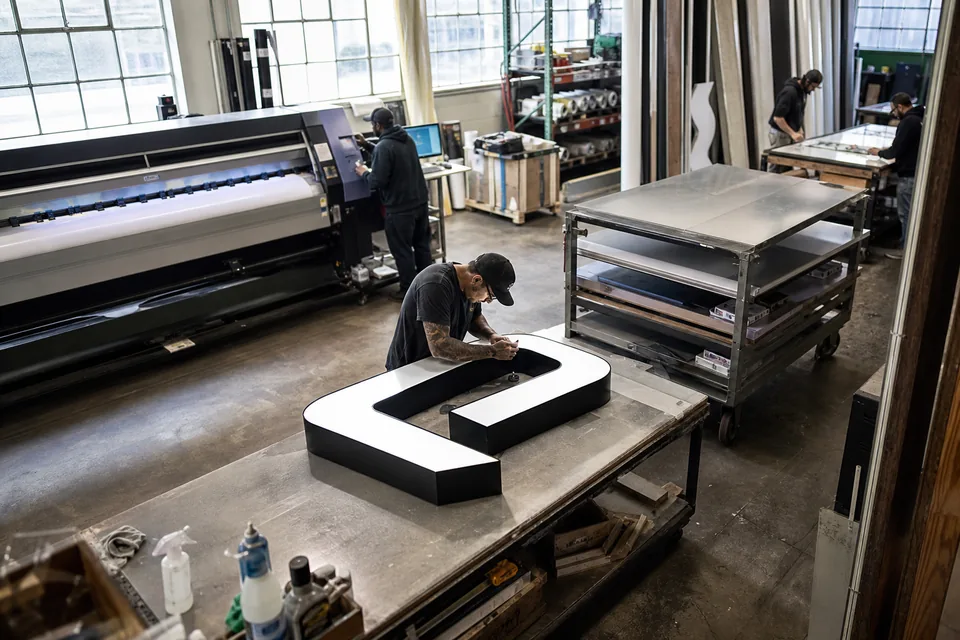
Shop time is where many estimates fall short. Price each machine at its own rate and each step at your labor rate.
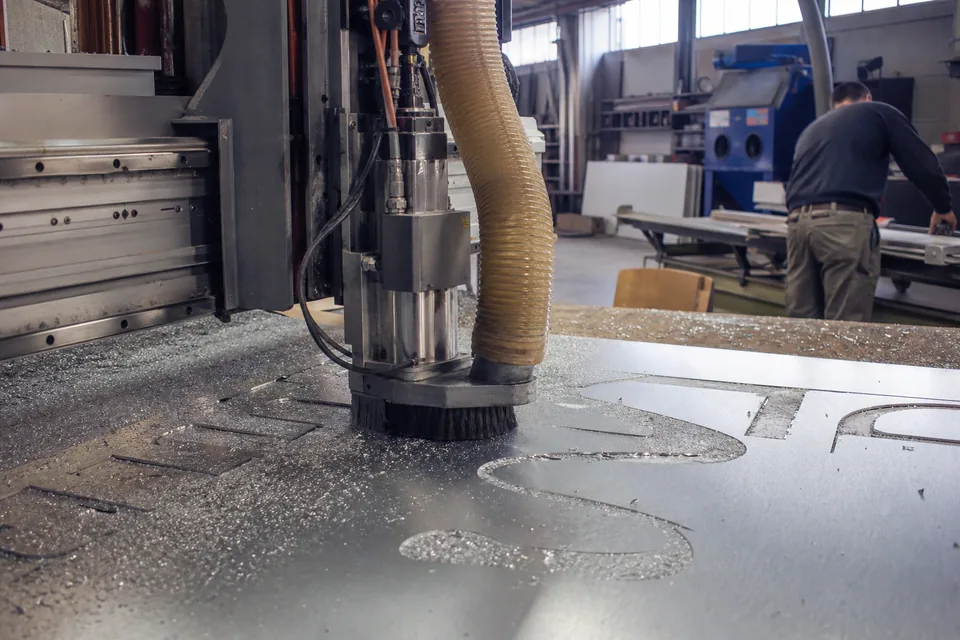
- Router, cutting faces and backs, 2 hours at $85 per hour in this example, $170.
- Bender, forming 96 feet of returns, about 2 hours at $75 per hour, $150.
- Assembly, joining returns to faces and backs, 1.5 hours per letter, 12 hours at $55, $660.
- LED layout and wiring, about 30 minutes per letter plus 1 hour for supplies, 5 hours at $55, $275.
- Paint labor, 4 hours at $55, $220.
Paint materials for faces and returns in two colors add about $160 in this example. Wire, connectors, sleeves and a disconnect switch add about $90.
Install crew, boom lift and travel
Install is often the biggest single line on a channel letter job. Price it from the survey, never from a guess.
- Crew of 2 for about 6 hours on site, 12 hours at $75 per hour in this example, $900.
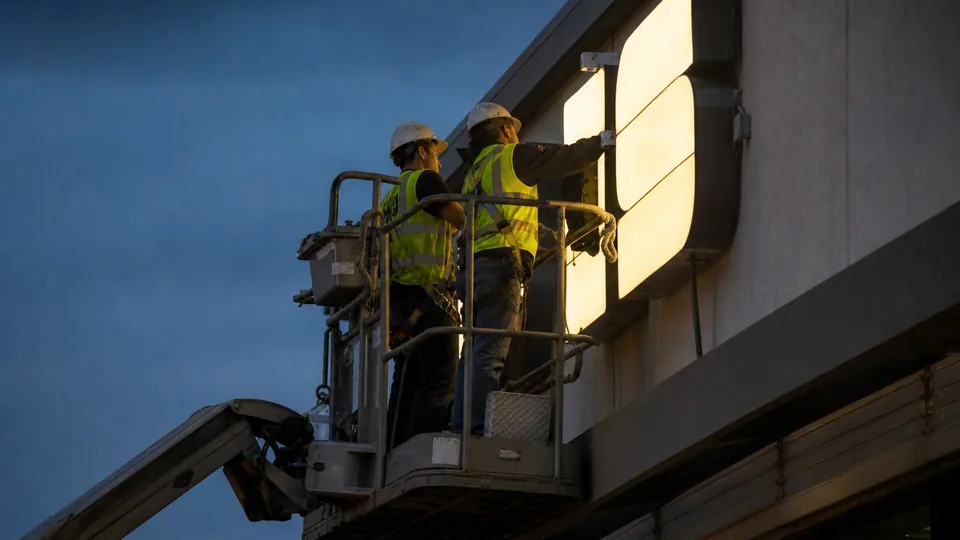
- Boom lift in the class that reaches about 22 feet with room to work, one day at $450 plus $150 delivery, $600.
- Travel, 30 miles each way, about 2.4 crew hours of drive time ($180) plus 60 miles of truck cost at 70 cents a mile ($42), $222.
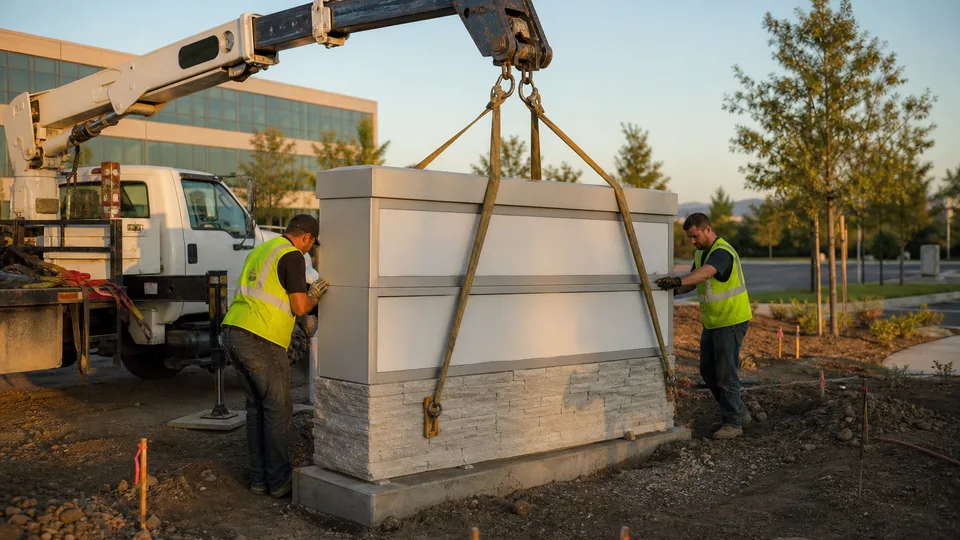
If the wall is over a sidewalk, add time for barricades and any right of way permit. If a lift cannot reach, you may need a crane with a mobilization fee. For a full walk through on install lines, read our guide on how to quote sign installation and see how sign installation estimating handles lift and crane classes by height.
Permits and electrical work
Most cities need a sign permit, and many need a separate electrical permit. Price both the fee and the office time to draw and file.
In this example the permit fee is $250 and filing takes 2 hours at $55, so the permit line is $360. A licensed electrician runs the primary circuit to the sign location as a subcontractor, $450 in this example.
Do not bury subcontractor costs inside your labor rate. Keep them on their own line so you can mark them up on purpose and see them in job costing later.
Overhead, margin and the sale price
Now add it up. Direct costs for the halo set in this example:
| Group | Example cost |
|---|---|
| Materials (faces, backs, returns, LEDs, supplies, hardware, wire, paint) | $1,658 |
| Machine time (router and bender) | $320 |
| Shop labor (assembly, wiring, paint, pattern) | $1,235 |
| Install (crew, lift, travel) | $1,722 |
| Permits | $360 |
| Electrical subcontractor | $450 |
| Direct cost | $5,745 |
Next, add overhead. Overhead is rent, utilities, office staff, software, insurance and every other cost that is not tied to one job. In this example the shop's overhead rate is $38 per hour, and the job uses about 38 shop and install hours. That adds $1,444, so the full cost is $7,189.
Set the price from margin, not markup. With a 35 percent target margin, the price is the cost divided by 0.65. That gives $11,060, or about $1,383 per letter in this example. The gross profit is $3,871.
A 35 percent markup would give only $9,705, which is a 25.9 percent margin. That gap is why the price on many quotes ends up thin. Read more in our guide on markup vs margin for sign shops.
If you want the full overhead math, our sign estimating method shows how to divide annual overhead by billable hours.
The same set as front lit letters on a raceway
Here is the front lit version of the same 8 letters, 30 inches tall, on an 18 foot raceway. Example numbers again.
| Line | Back lit (halo), direct | Front lit, raceway |
|---|---|---|
| Faces | $280 aluminum | $220 acrylic |
| Trim cap | None | $48 |
| Backs | $380 polycarbonate | $220 aluminum |
| Returns | $117 at 3 inch | $159 at 5 inch |
| LEDs | $346 (144 modules) | $461 (192 modules) |
| Power supplies | $165 (3 x 60 W) | $165 (3 x 60 W) |
| Raceway | None | $396 |
| Shop labor | $1,235 | $1,210 |
| Install crew | $900 (6 hours) | $600 (4 hours) |
| Full cost with overhead | $7,189 | $7,023 |
| Price at 35 percent margin | $11,060 | $10,805 |
The two prices land close, but for different reasons. Halo letters cost more in metal, polycarbonate and install time. Front lit letters cost more in LEDs, trim cap and raceway. If you had used one price per letter for both, one of the two quotes would carry the wrong margin.
Pricing open face letters
Open face letters follow the same steps with three changes.
- Face line is zero, or a clear face if the customer wants weather protection.
- LED or bulb layout is part of the design, so count by the visible spacing, not by a light chart.
- Paint labor goes up, because the inside of each return shows and needs a finished coat.
Returns are often deeper on open face letters, so check the coil price per foot for that depth. Exposed lights also mean more care with wiring and sealing, so add assembly time per letter.
A quick check before you send the quote
Run this check on every channel letter estimate.
- Letter type, height, count and font match the drawing.
- Stroke length and return length come from the art, not a guess.
- LED count matches the layout chart for the module and return depth.
- Power supplies are sized at 80 percent load.
- Raceway or direct mount is decided and priced.
- Lift class matches the survey height and access.
- Permit and electrical lines are on the quote.
- Margin, not markup, is at or above your target.
You can run the same steps on our pricing a channel letter sign page, which walks through the inputs for a set of your own.
Doing this in minutes instead of an hour
A full line-by-line channel letter estimate takes a lot of steps. That is why many shops fall back on price per inch. Sign estimating software keeps the steps and drops the busy work.
SignEstimator has templates for front lit, back lit and open face letters. You enter letter count, height and stroke, or upload the drawing or a photo of the wall. It counts LED modules per foot of stroke, sizes power supplies at 80 percent load, nests faces and backs on 4x8 and 5x10 sheets, and adds router, bender and assembly hours. Install, lift class, travel and permits come from your own rates. You see the sale price and the real margin before you send the quote.
The AI draft only fills in the spec. Pricing always uses your materials and rates, and you review every line.