Why install is the line that eats your profit
Most sign shops price fabrication well. They know their sheet cost, their router hours and their LED count. Install is different. It happens off site, it depends on weather and access, and it often gets a round number at the bottom of the quote.
That round number is where money leaks. A crew that runs two hours long, a lift that sits on site an extra day, a permit that needs a second trip to the city office: each one is small, and together they can wipe out the margin on the whole job.
The fix is simple. Break install into lines you can count. When every line has a quantity and a rate, you can see what you are charging for, and you can see what you missed.
- Crew hours on site, plus drive time
- Lift or crane by height class, plus delivery and pickup
- Permits, survey and engineering
- Travel, lodging and per diem on long jobs
- After hours, weekend and night work
- Removal and disposal of the old sign
- Electrical hookup and the electrician's time
- A weather and access risk allowance
Start with crew hours on site
Crew time is usually the biggest install line. Count it as people times hours times your loaded labor rate. A loaded rate is the hourly wage plus payroll tax, insurance, workers comp and benefits. If you pay an installer a base wage and use that base wage in your quote, you are underpricing every hour.
Estimate hours by task, not by gut feel. A set of channel letters on a raceway is a different job than letters mounted direct to the wall with a backer and pattern.
- Site setup and safety: cones, barricades, tie off, lift inspection
- Layout: snap lines, pattern hanging, drilling and anchors
- Mounting: lifting letters or cabinets into place, fastening, leveling
- Wiring at the sign: connecting power supplies, pulling wire through the wall
- Cleanup and walk through with the customer
Add drive time from the shop to the site and back. A crew that is on the road for 90 minutes is still on the clock. Many shops forget this on local jobs and only remember it on out of town work.
A simple crew hour method
Use a base time per task and adjust it for difficulty. Example numbers, use your own rates and history.
| Task | Base hours, 2 person crew | Adjust up when |
|---|---|---|
| Setup and safety | 0.5 | Busy sidewalk, traffic control needed |
| Layout and pattern | 1.0 | Uneven fascia, brick or stone |
| Mount channel letters on raceway | 1.5 | Over 20 feet up, wind |
| Mount letters direct with backer | 3.0 | More than 8 letters, script fonts |
| Hang cabinet sign | 2.0 | Double faced, heavy, no blocking behind wall |
| Wiring at the sign | 1.0 | Long wire run, no existing circuit |
| Cleanup and walk through | 0.5 | Customer wants changes on site |
Track real hours on every install for a month. After a few jobs your base times get accurate, and your quotes stop guessing.
Lifts by height class
Height drives the equipment, and equipment drives the cost. Group your jobs into height classes so the quote picks the right lift without anyone looking it up.
| Mounting height | Typical equipment | What to include in the quote |
|---|---|---|
| Up to 12 feet | Ladders or a small scissor lift | Your own gear, a small equipment charge |
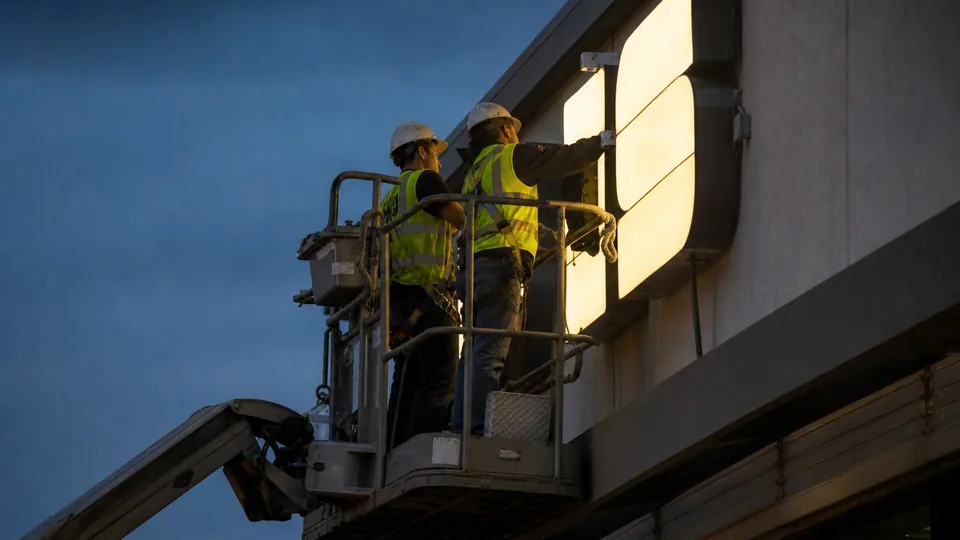
| 12 to 30 feet | Bucket truck or 30 to 45 foot boom lift | Your truck time or a rental day plus delivery |
| 30 to 60 feet | 60 foot boom lift | Rental day, delivery and pickup, operator time |
| Over 60 feet | Crane or 80 foot plus boom | Crane hours, mobilization, rigging, permit for street use |
If you own a bucket truck, still charge for it. Your truck has fuel, insurance, maintenance and an inspection schedule. Set an hourly or daily equipment rate and add it as its own line.
If you rent, quote the full rental period. Many rental yards charge a minimum of one day, or a four hour minimum, plus delivery and pickup. A job that needs the lift for two hours still pays for the minimum.
Cranes and mobilization
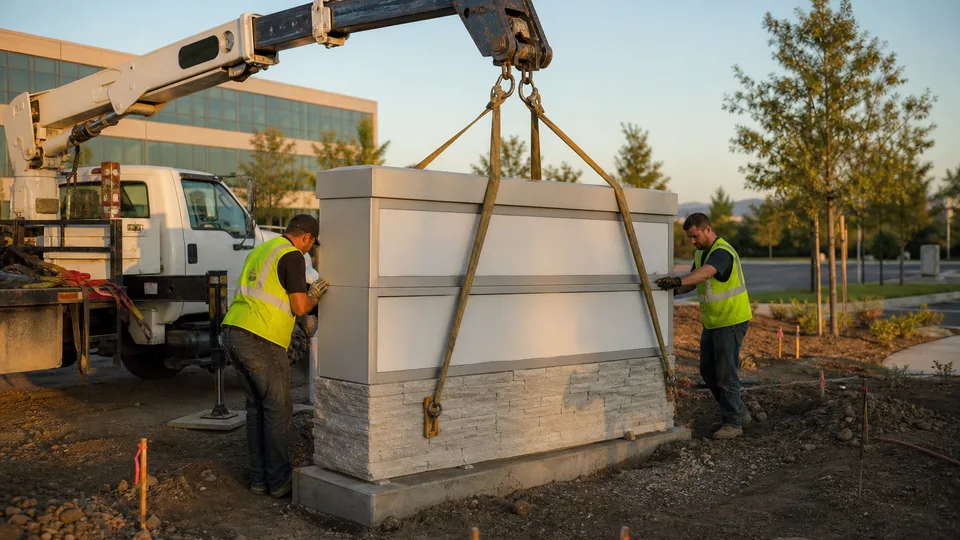
Cranes cost money before they lift anything. Most crane services charge mobilization, a minimum number of hours, and an operator. Some jobs also need a rigger, a lift plan, outrigger pads or a street permit to block a lane.
For a pylon or a large monument, ask for a crane quote early and paste it into your estimate as a subcontractor line. Then add your own handling time on top. Never let a crane quote arrive after you already sent the customer a price.
- Mobilization in and out
- Minimum crane hours, even if the lift takes 40 minutes
- Operator and rigger time
- Street or sidewalk permit if the crane blocks traffic
- Standby time if the crew is not ready when the crane arrives
Permits, survey and engineering
Permits are part of sign installation cost, and they take time as well as fees. Count both. The fee is what the city charges. The time is what your staff spends filling forms, drawing site plans, driving to the office and waiting for a decision.
- Site survey: measure the fascia, check the wall, find the power, photograph the space
- Permit drawings: elevation, attachment detail, electrical notes
- Permit fee: set by the city, so look it up for each job
- Engineering stamp: often needed for pylons, monuments and large wall signs
- Landlord approval: shopping centers often need sign criteria sign off
Charge the survey as its own line, or roll it into a design deposit. Either way, do not give it away. A survey you give away on a job you never win is pure cost.
Travel, lodging and per diem
Local jobs need drive time and fuel. Jobs out of town add more lines. Price them clearly so the customer sees why a job two hours away costs more than the same job down the street.
- Drive time for every person in the truck, both ways
- Mileage or fuel at a set rate per mile
- Lodging per person per night
- Per diem for meals
- Equipment hauling, such as a trailer or a second truck
After hours, weekends and nights
Retail tenants often want install before opening or after closing. Hospitals, airports and busy streets can force night work. Overtime and shift premiums change your labor rate, so apply a multiplier to the crew line, not a flat add on. A common approach is 1.5 times the loaded rate for after hours and 2 times for holidays, but set your own rule and use it every time.
Removal of the old sign
Taking down an old sign is its own job. It can take as long as the new install. There may be an old cabinet full of fluorescent tubes or ballasts, a raceway bolted into crumbling brick, or holes that need patching before the new letters go up.
- Removal labor, often 50 to 100 percent of the install hours for the same size sign in this example
- Disposal fees and the trip to the recycler or landfill
- Wall patching and paint touch up
- Capping old wiring safely
Electrical hookup
Illuminated signs need power. Some shops have a licensed electrician on staff. Others hire a subcontractor. Either way, price it. Ask the customer whether there is a dedicated circuit within reach of the sign. If there is none, the electrician may need to run a new circuit from the panel, and that changes the price a lot.
Separate the electrician's line from your crew line. If the electrician is a sub, paste their price and add your handling markup. If the electrician is staff, use their loaded rate, which is usually higher than your installer rate.
Weather and access risk
Wind stops boom lifts. Rain stops some adhesives and sealants. Snow stops everything. You cannot control the weather, but you can price the risk.
Add a small risk allowance to jobs with known risks: high installs, winter work, tight access, or sites far from the shop. A risk line of 5 to 10 percent of the install subtotal is one way to do it in this example. Some shops prefer a clause in the terms that charges a return trip if the site is not ready. The best quotes use both.
- Site not ready: the wall is not finished, power is not there, the old tenant sign is still up
- Wind or rain day: crew and lift booked, but no install possible
- Access problems: no parking for the bucket truck, landlord refuses lift on the sidewalk
A worked example of a full install quote
Here is one job priced line by line. A retail tenant needs a set of front lit channel letters on a raceway, 22 feet up on a strip mall fascia, 35 miles from the shop. The old cabinet sign comes down first. Example numbers only, use your own rates.
| Line | Quantity | Rate in this example | Cost |
|---|---|---|---|
| Site survey and photos | 1.5 hours | $75 per hour | $112.50 |
| Permit drawings and filing | 2 hours | $75 per hour | $150.00 |
| City permit fee | 1 | $185 | $185.00 |
| Remove old cabinet sign, 2 person crew | 4 person hours | $68 per hour loaded | $272.00 |
| Disposal of old sign | 1 | $90 | $90.00 |
| Install letters on raceway, 2 person crew | 7 person hours | $68 per hour loaded | $476.00 |
| Drive time, 2 people, round trip | 3 person hours | $68 per hour loaded | $204.00 |
| Mileage, 70 miles round trip | 70 miles | 70 cents per mile | $49.00 |
| Bucket truck, owned, half day | 1 | $250 | $250.00 |
| Electrician hookup, subcontractor | 1 | $380 | $380.00 |
| Weather and access allowance | 5 percent of install lines above | $108.43 | |
| Install cost before overhead | $2,276.93 |
Now add overhead and margin. In this example the shop runs an overhead rate of 15 percent on direct install cost and targets a 35 percent margin on install.
| Step | How | Result |
|---|---|---|
| Install direct cost | Sum of the lines above | $2,276.93 |
| Plus overhead at 15 percent | $2,276.93 times 1.15 | $2,618.47 |
| Sale price at 35 percent margin | $2,618.47 divided by 0.65 | $4,028.42 |
| Gross profit on install | Sale price minus cost with overhead | $1,409.95 |
Notice how far this is from a round number. A shop that writes "Install, $1,500" on this job loses money before the crew even leaves the yard.
If margin math feels slippery, read our guide on markup vs margin for sign shops. It explains why dividing by 0.65 is not the same as multiplying by 1.35.
How to present install on the quote
You do not have to show every line to the customer. Many shops show one install line on the PDF and keep the detail inside the estimate. What matters is that the detail exists, so you can defend the price when the customer pushes back.
- Show install as one or two lines: "Removal and disposal" and "Installation and electrical hookup"
- List what is included: permit, survey, lift, hookup, cleanup
- List what is not included: primary electrical work, wall repair beyond patching, night work unless stated
- Add a clause for return trips when the site is not ready
- Give the quote a clear expiry date, because rental and crane rates change
Good options help too. Offer a standard install and a night install as two choices, and let the customer pick.
Price install the same way on every job
Doing this by hand works for one quote. It breaks down when you write ten quotes a week and three different estimators each use their own shortcuts. That is where sign estimating software earns its keep.
SignEstimator keeps your crew rates, lift classes, travel rules and permit lines in one place. Enter the mounting height and the distance, and the estimate picks the lift class, adds drive time and mileage, and applies your overhead rate and target margin. You see the sale price and the real margin before you send anything. Read more about sign installation estimating.
On the Team plan, the install scheduling calendar shows crews and lift or crane availability, so the date you promise is a date you can keep. Job costing then compares actual install hours against the estimate, so your base times get better with every job.
- Height class picks the lift or crane line for you
- Distance adds drive time, mileage and lodging rules
- Removal, permit and electrical lines come from your templates
- Overhead rate and target margin apply the same way on every quote
- Real margin preview before the quote goes out
Want to see the fabrication side priced the same way? Our guide on pricing a channel letter sign covers faces, returns, LED modules and power supplies.
A quick checklist before you send an install quote
- Did you count drive time for every person in the truck?
- Does the lift match the mounting height, with delivery and the rental minimum?
- Is there a crane quote in hand for anything over your lift class?
- Did you include the permit fee and the time to file it?
- Is removal of the old sign priced, with disposal?
- Is the electrician on the quote, staff or sub?
- Did you add a risk line or a return trip clause?
- Did you apply overhead before margin?
- Does the quote say what is not included?
If every box is checked, your install line is a real number, not a hope.