
Five tests for sign shop pricing software
Run any tool you are considering against these five. If it fails two, the spreadsheet you already own is probably just as good.
- It prices from parts, not from a per-square-foot guess. Faces, returns, trim cap, backers, LEDs and power supplies each appear as lines.
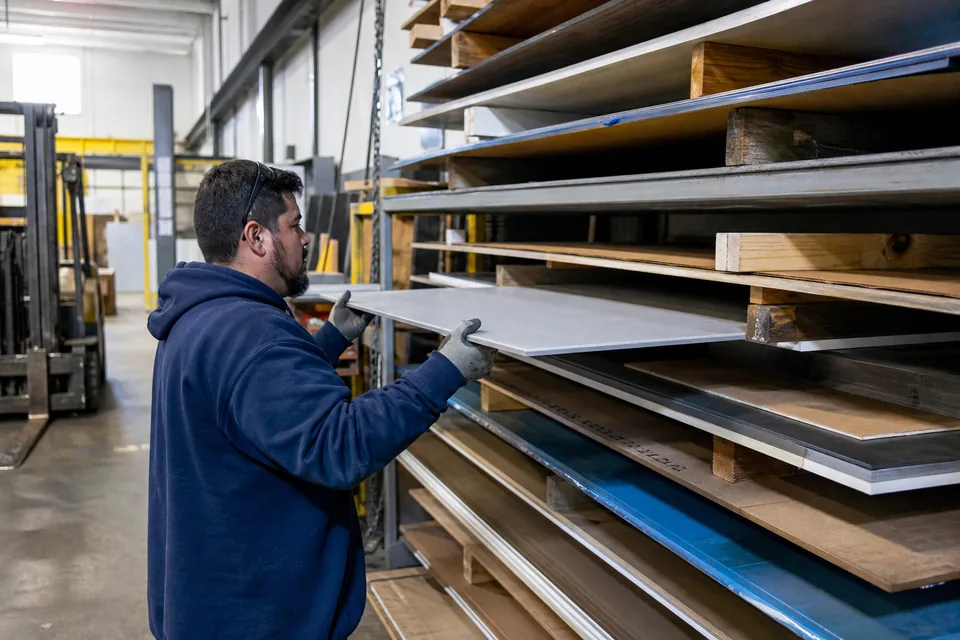
- It applies waste to sheet goods. A 4x8 or 5x10 sheet yields fewer letters than the area suggests. A tool that ignores nesting under-orders every job.
- It prices install as its own job. Crew size, hours, lift class by height, travel and permits.
- It shows margin, not markup. A 40 percent markup is a 28.6 percent margin. The tool should take a target margin and divide, or at least display the real margin. The math is in markup vs margin for sign shops.
- It uses your rates. Your labor rate, your machine rates, your overhead. A tool with fixed industry rates is guessing for you.
Many shops also want the quote to go out as a branded PDF the customer can approve online, and an export to QuickBooks Online or Xero so the accepted job becomes an invoice without retyping.
One 30 foot front lit channel letter job, priced two ways
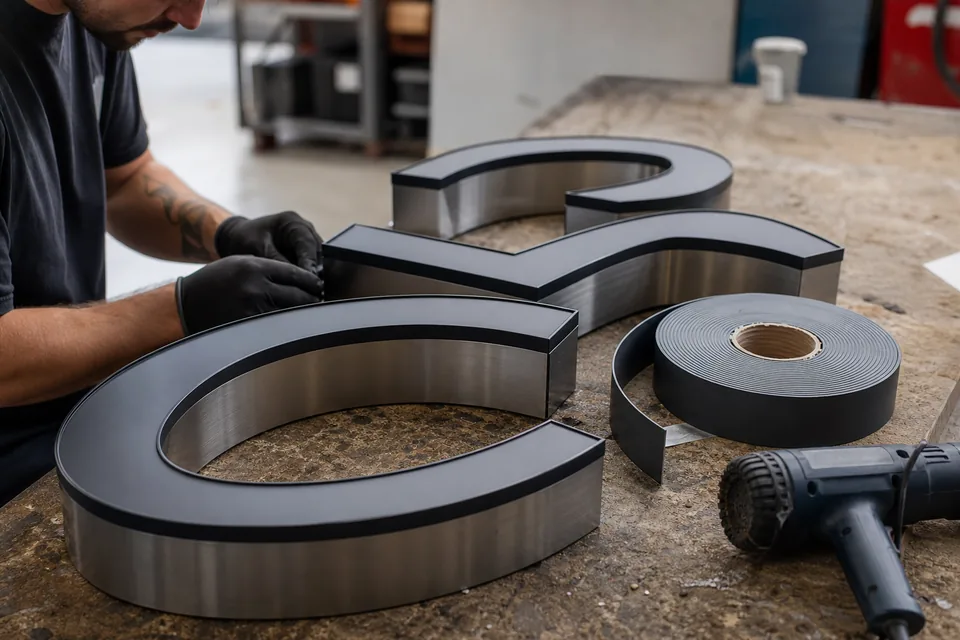
The job: 12 front lit channel letters on a raceway, 24 inches tall, about 30 feet of fascia, installed 18 feet up with a boom lift. These are example rates. The point is the method.
The spreadsheet version, built the way many shops started:
| Line | Spreadsheet |
|---|---|
| Letters, 12 at $95 each from last job | $1,140.00 |
| LEDs and power supplies, flat | $180.00 |
| Install, 6 hours at $55 | $330.00 |
| Cost total | $1,650.00 |
| Sale price, cost times 1.6 (a 60 percent markup) | $2,640.00 |
The line by line version, with every part counted:
| Line | How it is calculated | Amount |
|---|---|---|
| Aluminum and acrylic | Faces and returns from 4x8 sheets, 25 percent nesting waste | $412.00 |
| Trim cap and fasteners | 118 feet of trim cap plus hardware | $96.00 |
| LED modules | 190 modules at $1.05 | $199.50 |
| Power supplies | 3 units of 60 W at $38 | $114.00 |
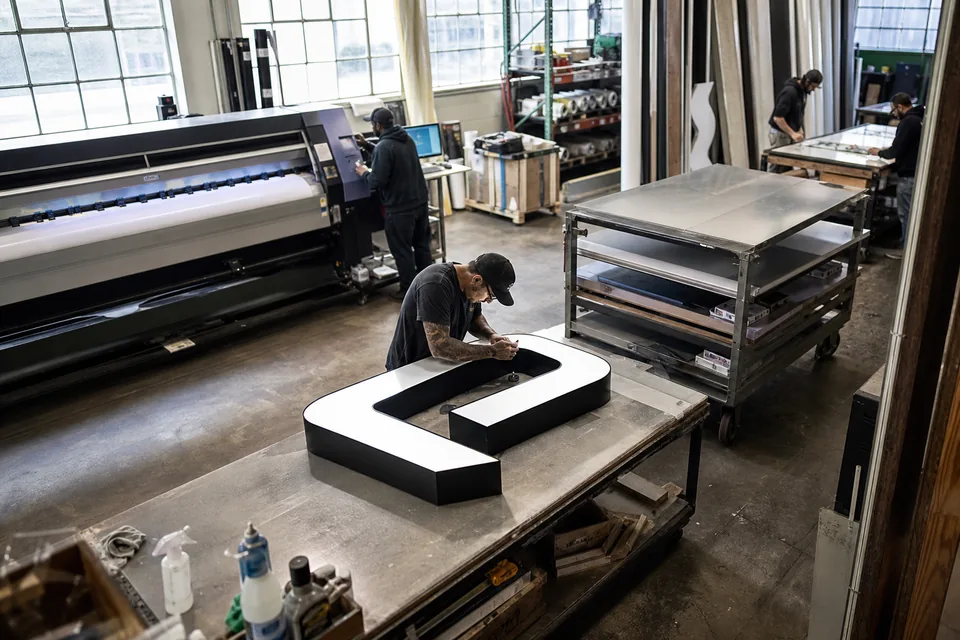
| Router and bender time | 7 hours at $60 | $420.00 |
| Assembly and wiring | 8 hours at $55 | $440.00 |
| Raceway, paint and mounting hardware | Raceway, paint, anchors | $168.00 |
| Install labor | 2 installers, 5 hours each at $55 | $550.00 |
| Boom lift | 1 day rental | $285.00 |
| Travel and permit | 1.5 hours at $55 plus permit fee | $142.50 |
| Direct cost | Sum | $2,827.00 |
| Overhead | 20 percent | $565.40 |
| Cost with overhead | $3,392.40 | |
| Sale price at 40 percent margin | Cost divided by 0.60 | $5,654.00 |
The spreadsheet quoted $2,640.00. The parts quote is $5,654.00. Even if the customer pushes back and you sell it at the spreadsheet price, the true cost with overhead is $3,392.40, so the job would lose $752.40 before anyone is paid for it. Nothing in the spreadsheet was a lie. It simply never had a row for the lift, the nesting waste or the overhead, and the markup was applied to an incomplete cost.
Example numbers, use your own rates.
Where the missing money hides
Looking at the gap, three lines account for most of it.
- Lift and travel. A $285 rental and the drive are easy to forget because they are not material. Lit signs above reach need them on most jobs. The installation side is covered in how to quote sign installation.
- Machine time. Router and bender hours do not show up on a materials invoice, so they vanish unless the template carries them.
- Overhead. A markup on cost is not overhead recovery. If overhead is 20 percent of cost and the markup is applied to an incomplete cost, the shop pays the rent out of the margin.
A spreadsheet can carry all of this. Shops that manage it keep one tab per sign type, one tab of rates, and one person who knows how the formulas chain. The failure is rarely the first quote. It is the fiftieth, when someone copies last year's file and the material price in cell F12 is stale.
Four kinds of tools that get called pricing software
| Type | What it does well | Where it falls short | Typical fit |
|---|---|---|---|
| Spreadsheet | Free to start, fully flexible | No guardrails, stale prices, one person holds the logic | Very small shops with few sign types |
| Generic quoting app | Fast PDFs and e-signature | No sign parts, waste, lift or margin logic | Service trades, not fabrication |
| Full shop management system | Quotes, production boards, invoicing, customer portal | Pricing logic is templates, plans start in the hundreds per month | Multi-department shops that want one system |
| Sign estimating engine | Counts parts, waste, machine and install time, shows margin | Not a full accounting or inventory system | Shops whose bottleneck is quoting accuracy |
We compare real plan prices for shop systems in sign shop software cost by vendor and shop size, and the options side by side in best sign shop software compared. Many shops pair an estimating engine with the accounting system they already use.
How SignEstimator prices the same job
You pick a front lit channel letter template, enter the letter height, count and install height, and the engine produces the lines in the second table from your material library and rates. It counts the LED modules and the 60 W or 100 W power supplies, applies waste for 4x8 and 5x10 sheets, adds router and bender hours at your machine rates, sets crew and lift class from the install height, and applies your overhead and target margin. The sale price and real margin show before you send.
Customers can send a storefront photo, an elevation drawing or an email with sizes, and the AI draft turns it into a spec. Pricing still runs on your rates, and you check every line. Solo is $24 a month billed yearly ($49 monthly), Shop is $74 yearly ($149 monthly) with up to 5 seats and good better best options, Team is $199 yearly ($399 monthly) with a jobs board and install calendar, and Multi-location is $449 yearly ($899 monthly). All plans have seats included, with no per-user fee. There is no free plan, but the homepage runs one demo estimate without an account.
For lit letter jobs specifically, see channel letter estimating software. To quote vehicle wrap fleets, see vehicle wrap estimating software. The sign pricing calculator handles quick one-off checks.
What is the best pricing software for a sign shop?
The best pricing software for a sign shop counts parts, applies waste, prices install and lift separately, and shows margin on every quote. Shops that need production and invoicing in one system look at shopVOX, SignTracker or CoreBridge. Shops whose problem is quote accuracy look at an estimating engine such as SignEstimator.
Is a spreadsheet good enough for sign pricing?
A spreadsheet is good enough while you sell a few sign types and one person maintains it. It fails when material prices go stale, the lift or travel rows get skipped, or someone copies an old file. The worked example above shows a spreadsheet missing $3,014 of sale price on one channel letter job.
How do I set a margin on sign jobs?
Choose a target margin and divide cost by one minus that margin. Cost of $3,392.40 at a 40 percent margin sells at $5,654.00. A 40 percent markup on the same cost sells at $4,749.36, which is only a 28.6 percent margin. Overhead belongs in cost first. The IRS guide to business expenses helps you list what counts.
How much does sign shop pricing software cost?
Estimating tools run from about $24 a month for a solo shop to $449 a month for unlimited seats on yearly billing, and full shop management systems run from about $65 to $899 a month depending on users and tier. Compare yearly totals, onboarding fees and per-user charges before you decide.
Do I need to replace my accounting software?
No. Pricing software feeds your accounting. SignEstimator exports accepted quotes to QuickBooks Online or Xero as invoices on the Shop plan and up. It does not connect to QuickBooks Desktop.
Run your last job through it
Take a job you quoted last month and price it again from its parts. Put the new total beside the number you sent. If your shop is also thinking about its own sale price someday, a quick estimate from a tool such as businessappraisal.ai shows what the margins you set today are worth. Then start with the SignEstimator pricing plans and quote the next job the same way every time.